Peak Season Bakery Operations: Capacity Planning, Rosters, and Margin Protection
Run peak bakery seasons with practical controls for demand planning, labour coverage, dispatch timing, and margin protection under Australian conditions.
Quick Answer
- Peak season stability comes from early demand planning, clear order cut-offs, and protected production windows.
- Use practical capacity ranges and daily KPI checks instead of optimistic volume assumptions.
- Protect margin by controlling custom-order complexity, staffing buffers, and remake risk during high-pressure weeks.
Peak season in a bakery is where routine systems either hold or break. Demand spikes, absences, and supplier delays can stack quickly. The operators who stay profitable in these windows use clear limits, practical planning ranges, and daily control checks rather than last-minute heroics.
Quick Answer
- Plan early: set demand, staffing, and supplier assumptions several weeks before peak demand arrives.
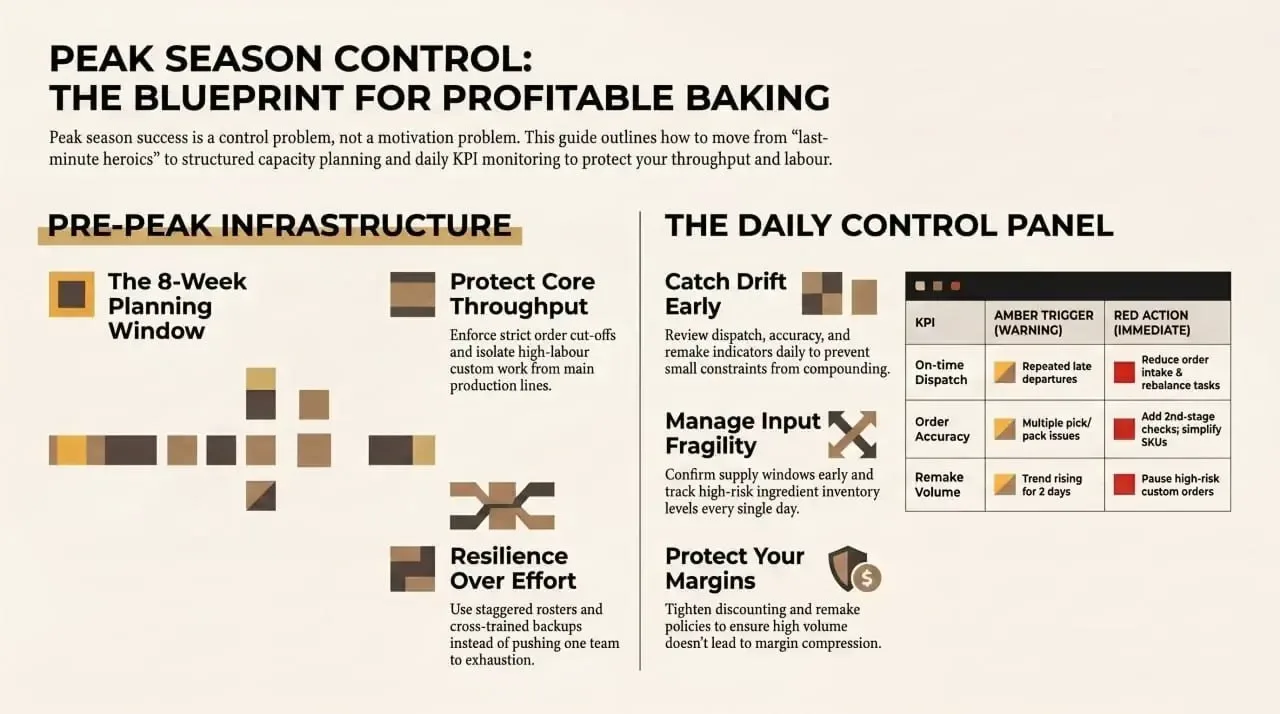
- Protect throughput: enforce order cut-offs and isolate high-labour custom work from core production lines.
- Control daily: review dispatch, accuracy, remake, and margin indicators each day to catch drift early.
Why Peak Seasons Break Bakeries
Most breakdowns are not caused by one major event. They come from small constraints compounding: delayed ingredients, overtime fatigue, overloaded proofing windows, and late custom-order changes. Without defined limits, teams absorb pressure until quality and service slip.
Before entering peak periods, stress-test your production timing against known choke points using your production timing workflow and the consistency controls in proofer setup and humidity management.
Peak Season Control Panel
| KPI | Green range | Amber trigger | Red action |
|---|---|---|---|
| On-time dispatch | Stable and predictable by route | Repeated late departures across shifts | Reduce order intake and rebalance shift tasks immediately |
| Order accuracy | Minor corrections only | Multiple pick/pack issues in one day | Add second-stage pack checks and simplify SKU handling |
| Remake volume | Within normal variance band | Trend rising for two consecutive days | Review process bottleneck and pause high-risk custom orders |
| Labour variance | Within rostered tolerance | Overtime pressure increasing across teams | Deploy cross-trained backup and shorten complexity in product mix |
| Margin trend | Protected across core lines | Margin compression despite higher volume | Tighten discounting, delivery commitments, and remake policy |
Capacity Planning and Order Controls
Build peak plans from realistic throughput ranges, not best-case output. A practical method is to lock a conservative baseline, then add controlled uplift only where teams have demonstrated repeatable performance. If demand exceeds the safe window, use waitlists and cut-offs instead of overpromising.
If you are scaling wholesale commitments at the same time, align cut-offs and dispatch promises with retail-to-wholesale operating controls so revenue growth does not erode service quality.
Labour Coverage and Fatigue Risk
Peak performance depends on resilience, not just effort. Cross-training, staggered shifts, and protected break structure usually outperform pushing one core team beyond sustainable limits. Fatigue drives errors, and errors drive remakes, delays, and customer churn.
Use practical staffing buffers and pre-assigned backup roles. Link this to your compliance routines in bakery food safety compliance so pressure does not compromise standards.
Supplier and Input Stability
Peak periods expose input fragility. Confirm key supply windows early, maintain approved alternatives, and track high-risk ingredients daily. Where flour behaviour shifts under seasonal conditions, monitor with the controls in flour selection for Australian baking conditions.
Download: Peak-Season Operations Control Blueprint
If you want a practical floor-level checklist, the infographic below is a visual preview of the full operator playbook. Download the full 15-page playbook below.
Download the full 15-page playbook
Get future operator playbooks by email
FAQ
How early should a bakery start peak season planning?
Most operators start structured planning 6 to 8 weeks before major demand spikes.
Should bakeries cap custom orders during peak weeks?
In most cases, yes. Controlled caps reduce operational volatility and protect high-volume repeat lines.
What roster model works best in peak periods?
Staggered rosters with cross-trained backups generally provide stronger resilience than thin staffing with heavy overtime.
How should supplier risk be managed during seasonal surges?
Confirm allocations early, retain fallback suppliers, and review critical inventory daily during peak windows.
Which KPIs should be checked daily during peak season?
Focus on dispatch timeliness, order accuracy, remake volume, labour variance, and margin trend.
Operational Takeaway
Peak season success is a control problem, not a motivation problem. Use practical capacity ranges, enforce boundaries, and monitor daily indicators so the business scales demand without sacrificing quality or margin.
Frequently Asked
- How early should a bakery start peak season planning?
- A practical baseline is 6 to 8 weeks before expected demand spikes. This gives enough time for supplier commitments, roster planning, and production sequencing.
- Should bakeries cap custom orders during peak weeks?
- Usually yes. Controlled caps on complex custom orders help protect throughput for repeat lines and reduce late-stage disruptions.
- What roster model works best in bakery peak periods?
- Most operators use staggered coverage with cross-trained backups. The goal is resilience to absences and fatigue, not maximum hours from a small core team.
- How should we manage supplier risk during seasonal surges?
- Confirm primary orders early, keep approved fallback suppliers, and track critical inputs daily during peak windows.
- Which KPIs should be reviewed daily in peak season?
- Track on-time dispatch, order accuracy, remake volume, labour variance, and margin trend. These indicators show pressure before service failures become visible.